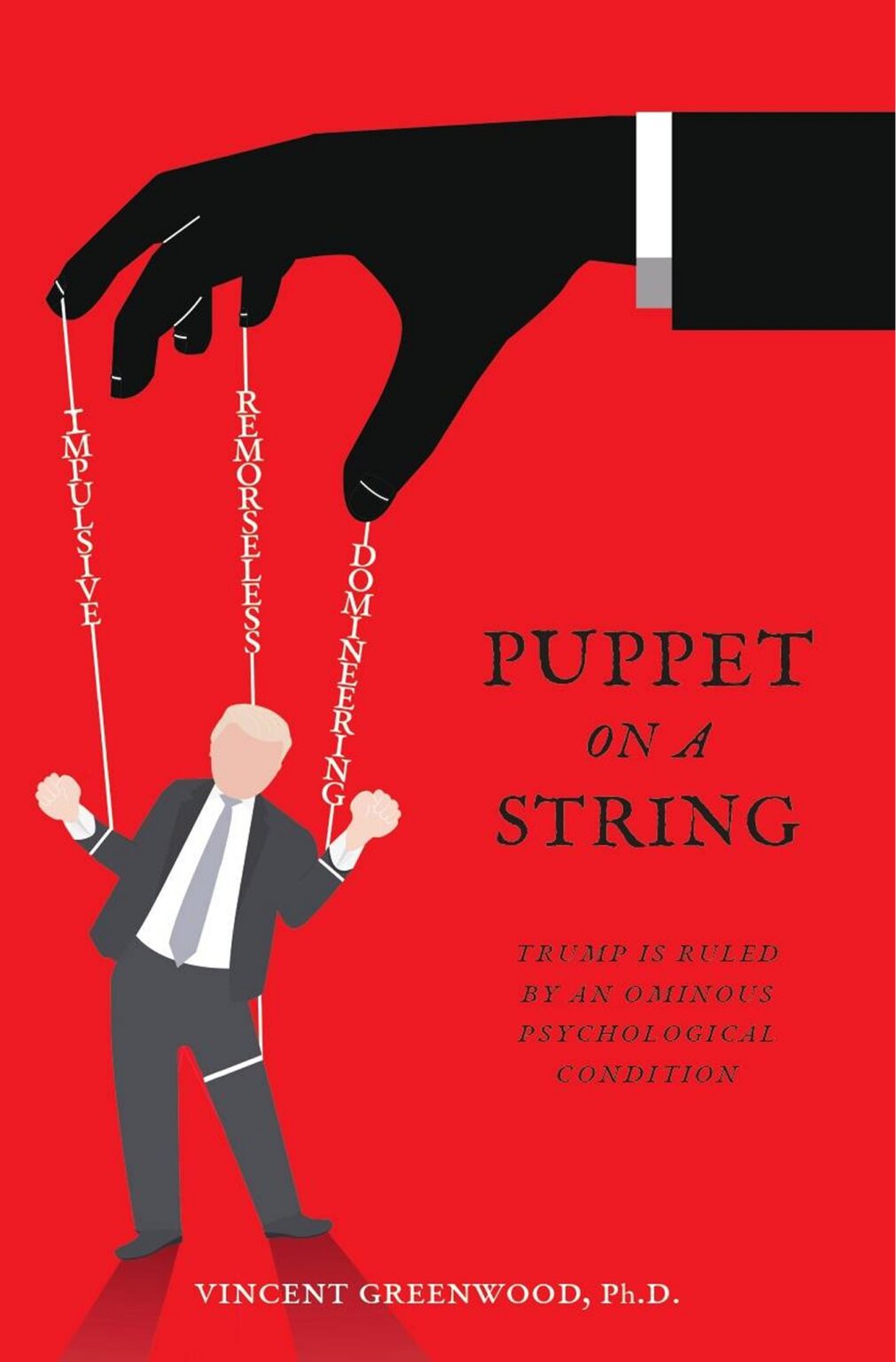
Dr. Vincent Greenwood’s new book, Puppet On A String, presents a forensic-style psychological examination of Donald Trump. Pre-Order Now

Do you want to forcefully respond to charges of ‘Trump derangement Syndrome’?

Then read this detailed, evidence-based psychological examination of Donald Trump’s personality through the lens of clinical psychopathy, a well-researched, strongly

validated condition.
*Available September 22, 2026 - ISBN 978-1-64343-418-6

Advance praise

About this book

After reading this forensic-style analysis, you will not be able to look at Donald Trump in the same manner. You will understand his deep psychology, the puppeteer psychopathology pulling his strings. You will have a cheat code. You will learn that, seemingly, the most powerful man in the country is in the throes of a personality condition – manifested by a limited, precise, and implacable set of personality traits – that leaves him with few cards to play and inevitably inflicts harm and havoc on all those in his orbit.

Puppet on a String provides an assessment that meets the gold standard of reliability, validity, and rigor and thus separates fact from hyperbole in evaluating Donald Trump’s mental health. This forensic-style analysis is more than an informed opinion because it:

The clear and convincing investigation will explain Trump’s dizzying array of behavior. Puppet on a String will also explore how his condition may contribute to his political prowess and the threat it poses to our democratic order

A message from the author

The Essence of the Condition

Dr. Vincent Greenwood on the case for this book

Inside The Book

Chapter 1
A Different Creature

The dance moves of this personality condition are controlled by a puppet master with perverse aims. Let’s meet that psychological taskmaste

Chapter 2
The Gold Standard

How can we turn observational and life history data into a reliable measure of clinical psychopathy? By employing an empirically sup- ported and rigorously vetted behavioral rating scale designed to mea- sure the condition.

Chapter 3
The Envelope, Please

From the cradle to the Oval Office, the trail of evidence tells a con- sistent and troubling story. Herein are the receipts of that evidence, which provide a bill for one deep-seated and troubling trait after another.

Chapter 4
The Three Strings

Science uncovers the powerful gears that drive his behavior. We finally now have a cheat code to deconstruct the chaos.

Chapter 5
IF ONLY HE WERE JUST A SEVERE NARCISSIST

“The difference between the almost right word and the right word is really a large matter—it’s the difference between the lightning bug and the lightning.” —Mark Twain The duty to perform differential diagnosis is imperative. We need to focus on the trunk of his condition and not be distracted by its various colorful branches.

Chapter 6
DONALD TRUMP, SKILLED POLITICAL SUPERSTAR?

The political power Trump has amassed is impressive. But much of the credit goes to his destructive personality traits. Trump is born to dominate; but it’s all in one ruthless gear that can trample the innocent.

Chapter 7
DONALD TRUMP AND AUTHORITARIANISM: A PERFECT MARRIAGE?

You’d think so. But his condition more strongly suggests that Trump can’t help but undermine any form of governance, though the price to the governed will be heavy in the form of havoc and harm. What have we learned in the second Trump administration? Don’t follow the ideology; follow the traits.

Chapter 8
WHERE IS THE NEXT JAKE TAPPER?

We need more light shone on the psychiatric emergency that so many feel, but no one calls out. The elephant in the room is not a political party; it’s not even a man; it’s a condition.
Chapter 1
A Different Creature
Chapter 2
The Gold Standard
Chapter 3
The Envelope, Please
Chapter 4
The Three Strings
Chapter 5
If Only He Were Just a Severe Narcissist
Chapter 6
Donald Trump, Skilled Political Superstar?
Chapter 7
Donald Trump and Authoritarianism: A Perfect Marriage?
Chapter 8
Where Is the Next Jake Tapper?

Press kit

For media inquiries, please contact Holly Watson at

About THE Author

Dr. Greenwood created DutyToInform.org in 2020 to disseminate scientifically valid findings about President Trump’s personality condition and accompanying psychological struggles and destructive behavior patterns. He has published numerous articles on his findings, including two chapters in The More Dangerous Case of Donald Trump (2024), edited by Bandy X. Lee. He has appeared on numerous political shows and podcasts, including The Bill Press Show, The Damage Report, and Shrinking Trump.

*Available September 22, 2026

Contact Author

I welcome thoughtful comments from readers across the political spectrum. While I may not be able to respond individually, I appreciate constructive feedback, questions, and corrections supported by evidence. If there is an issue I should address in a future edition, please let me know.

Get your
copy today!

A forensic-style psychological examination of Donald Trump through the lens of clinical psychopathy — evidence-based, rigorously cited, and unlike anything else written on the subject.

Available September 22, 2026

Introduction

This book is about a puppeteer, his puppet, and their prey. The puppeteer is a relatively rare psychopathological condition called clinical psychopathy, a condition of a set of destructive personality traits that has been the object of much scientific study. This condition is unique in that it preys on not only its patient but also on the many people in the patient’s orbit.

Linking a diagnosis of this condition to an individual, particularly one who wields significant influence over others, has profound implications for collective well-being. We have a good understanding of the condition. Clinical psychopathy has been the focus of significant research efforts. Tens of thousands of studies4 reference the diagnostic instrument used to identify the disorder. It is one of the best understood, precisely delineated, and thoroughly validated conditions in the field of psychopathology.

In these pages, you will learn a good deal about clinical psychopathy. You will learn about the causes of this disorder, how it manifests early in life, its impact throughout one’s lifespan, the possibilities for treatment, and, most importantly, the fine details of its defining characteristics, including the particular dangers associated with it. Puppet on a String will read in part like a clinical psychology textbook, albeit focused primarily on this one condition. If I have done my job, you should have a broader and deeper understanding of clinical psychopathy and the ominous implications of the condition. I also hope to provide you with a “cheat code” to help you cope with a well-known individual high in psychopathic traits. So many of those in the clinical psychopath’s path will eventually feel overwhelmed, enraged, and exploited.

The best advice in dealing with psychopaths is to avoid them if possible. When that is not possible, the best tool is understanding, which can help you make a realistic assessment of the threat you face, anticipate the particular harm a clinical psychopath can unleash, and call out their predictable machinations and norm-shattering behavior. A cheat code that details their nature and manipulations can help us claw back some sense of empowerment.

The puppet this book analyzes is Donald J. Trump. In this metaphor, Trump’s behavior appears controlled by the traits described in the psychopathy literature, not unlike a puppet controlled by a puppeteer. He is dancing on the strings of precisely defined behavioral patterns. Up close, Trump is dramatic, flamboyant, unrestrained, and unpredictable; yet he appears to be in control of his actions. But from the fly loft above the stage, where the puppeteer that is this condition works, his behavior is very predictable, including his pattern of chaos. He may proclaim he is a “stable genius” and play the strongman well, but he appears to be at the mercy of a vicious and controlling pathology.

Love him or hate him, we would all agree he seems unique. Trump can seem almost like a skilled performance artist adept at capturing attention in our current political crisis. He is unmoved by the wrath directed at him by his political opponents. This defiance, coupled with his ability to troll the libs, is central to his appeal. Supporters and detractors would agree that he is mesmerizing in a disturbed way and seems to operate in a realm of his own making. However, as I will detail, his behavior is anything but unique.

Even if the perch he commands is remarkable, his behavior, when viewed through the lens of the psychopathy literature, resembles patterns commonly described in research on individuals high in psychopathic traits. He is more of a puppet to his personality traits than a master of them.

Clinical psychopaths place immense focus on winning at all costs, typically fueled by a deceitful and manipulative mindset that can leave the rest of us in the dust. Almost all of us have humanizing emotions that temper our more selfish and exploitative sides. However, a small minority of people (fewer than 1 percent) are simply unable to experience two kinds of humanizing emotions: the ability to bond with and have empathy for others, the absence of which leads to callousness; and the ability to experience shame, guilt, or anxiety, the absence of which leads to remorselessness. A clinical psychopath’s relationships—whether with their partner, acquaintances, colleagues, or even country—are one-sided and instrumental. In every choice a clinical psychopath makes, their desire for dominance and exploitation prevails over others’ welfare.

The clinical psychopath may not look dangerous, but all those in their immediate habitat are prey to their what’s-in-it-for-me and win-at-all-costs nature. The most vulnerable targets are those that the psychopath can exploit to attain their selfish aims, which often boil down to sex, money, and, most critically, heightened status from increased power or attention.

Trump’s temperament shares many similarities to other diagnosed clinical psychopaths described in the academic and clinical literature. He employs boasting, bullying, lying, and cheating to get what he wants. From the many biographies of Trump, there are innumerable examples of cruel and predatory behavior. As a child, Donny’s callousness and bullying were directed against his siblings, neighbors, and classmates. As a young and middle-aged man, Donald’s set of destructive personality traits were directed against women, employees, tenants, business associates, business rivals, and acquaintances (exempting the category of close friends only because, like most clinical psychopaths, he didn’t seem to have any). In late adulthood, Trump expanded his controlled territory from Queens to Manhattan, then from Washington, DC, to across the globe.

The White House is not only open for business for the Trump family but also for the subjugation of any person, place, institution, branch of government, strategic partner, country, or norm that poses a threat to his dominance and selfish aims. Many would point to his lawless foreign interventions and brutal immigration policies in America and conclude: The world is his prey.

PuPPet on a String will also address a puzzle: If Trump is at the mercy of a rigid personality disorder that limits his functioning, how do we account for his success? Surely winning the presidency twice counters the notion that he could be a severely disturbed and compromised clinical entity.

Here, we enter a territory where two things can be true at the same time. By the time they lie down on their deathbed, most psychopaths’ lives have ended in ruin. Forensic psychologist Robert Hare notes, “Psychopaths leave behind them a long trail of broken hearts, shattered expectations, and empty wallets.” When you live a selfish, conscienceless life, that’s how it often ends. But many clinical psychopaths have enjoyed material and reputational success along the way. When a person focuses on winning at all costs, it often doesn’t hurt to be freed from the shackles of remorse or restraint. We will see how the defining traits of psychopathic personality disorder turn out to be assets for our current political moment: telling big lies undaunted by shame or fear of criticism; showcasing transgressive, thrilling behavior without a hint of restraint; and being willing to display cruelty without a glimmer of empathy. It is easy to condemn these behaviors, but they are proven attention-grabbers.

Trump has demonstrated superiority in dominating our screen-addicted attention economy. He knows how to grab and hold attention, and holding attention, particularly in provocative ways (welfare of the country be damned), is power.

Trump also knows how to speak the language of grievance and resentment, which is at the heart of his appeal to a large swath of the country. Clinical psychopaths often feel aggrieved and therefore have a lifetime of mastering the language of victimization. They effortlessly, naturally, and dramatically blame others (“We pledge to you that we will root out . . . the radical left thugs that live like vermin within the confines of our country, that lie and steal and cheat on elections”). Conservative voters and politicians either don’t catch his inaccuracies or disregard them, and his domineering speeches even enhance his political success. Despite his success, his grandiose communication style isn’t a political strategy—it’s been part of his personality for a long time. As Trump said in a 1990 Playboy interview on his displays of wealth, “The show is ‘Trump.’ And it is sold-out performances everywhere.”

Now that he’s president, the nation is bound to his performance, unable to leave the theater. When Trump kept repeating, “You don’t have the cards” to Ukrainian President Volodymyr Zelenskyy during their fateful Oval Office meeting in February of 2025, he might as well have been talking to the country at large. We must acknowledge that Trump has some powerful cards to play at this fraught moment in our history, from a base willing to be incised to an uprising at the Capitol to political allies determined to use Trump’s disregard for the law to their advantage.

The volume of Trump’s lies and exaggerations creates chaos—the news cycle scrambles to debunk his claims, voters lose faith in their elections, and citizens struggle to grapple with inconsistent policies on issues from tariffs to warfare. Trump’s political expression, in the context of his behavioral patterns, is predictable, even if it’s predictably erratic. We can liberate ourselves from this chaos. This book aims to overlay Trump’s traits onto the strict research criteria for a condition that could explain and illuminate his behavior. There’s power in clinical understanding. Puppet on a String can deal some better cards to all those who watch with horror as Trump casts their hard-earned liberties and securities into the betting pot.